Capsule Fill Weight Calculator: How to Calculate the Right Dose for Your Formulation
Selecting the correct capsule size for a pharmaceutical or nutraceutical formulation is not a guess — it is a calculation. Formulators and production teams who get this right the first time avoid expensive capsule size changes mid-development, filling machine downtime, and failed regulatory submissions.
This guide from Universe Capsules, an empty hard gelatin capsule manufacturer in India, explains how to calculate capsule fill weight correctly — and includes a free interactive calculator you can use right now.
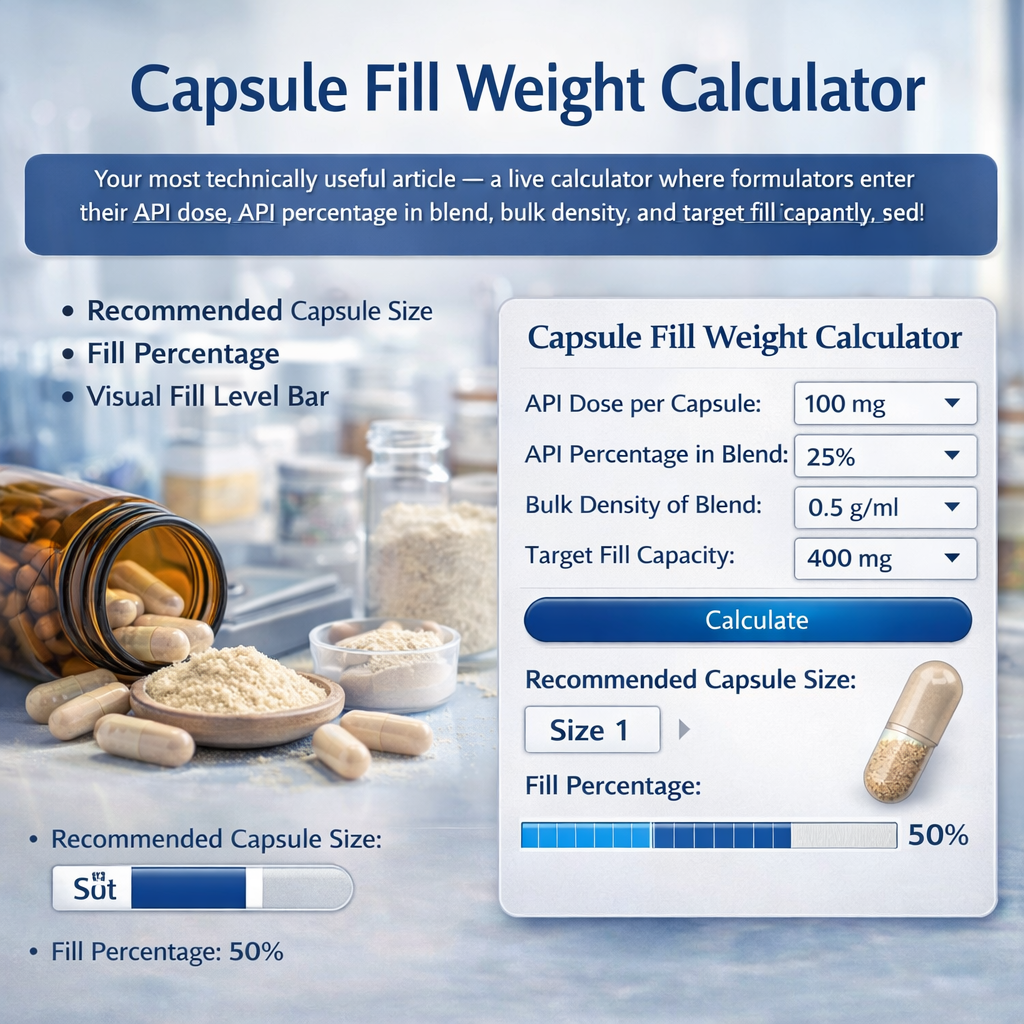
Capsule fill weight calculator
Enter your formulation parameters to find the correct capsule size and calculate target fill weight.
The amount of API required per capsule unit
% of total blend that is active ingredient
Measure by tap density test. Typical range: 0.4–0.9 g/ml
Total blend weight per capsule—
Required fill volume—
Recommended capsule size—
Capsule fill %—
Capsule size visual reference
000
1.37 ml
00
0.91 ml
0
0.68 ml
1
0.50 ml
2
0.37 ml
3
0.27 ml
4
0.20 ml
5
0.13 ml
Step-by-step fill weight calculation method
Step 1: Determine target dose and blend composition
Begin with your API dose per unit (mg). If your blend contains excipients, calculate the total blend weight per capsule by dividing the API dose by the API percentage in the blend. For example: 400 mg API at 80% API content in blend = 500 mg total blend per capsule.
Step 2: Measure bulk density of your blend
Measure the bulk density of your actual powder blend using a tap density apparatus or simple graduated cylinder method. Do not use literature values — bulk density is highly specific to your combination of API, excipients, particle size distribution, and moisture content. Measure at least three replicates and use the average.
Step 3: Calculate required fill volume
Divide the total blend weight (in grams) by the measured bulk density (in g/ml):
Required volume (ml) = Blend weight (g) ÷ Bulk density (g/ml)
Example: 0.500 g ÷ 0.65 g/ml = 0.769 ml required
Step 4: Select capsule size at 80–90% fill capacity
Find the capsule size whose total volume, when multiplied by your target fill percentage (80–90%), equals or exceeds your required volume. From the example above: 0.769 ml ÷ 0.85 = 0.905 ml minimum capsule volume needed → select Size 00 (0.91 ml capacity).
Step 5: Verify weight uniformity tolerance
Once you have selected the capsule size, verify that your filling machine's weight uniformity at this fill weight meets the pharmacopoeia specification. IP/BP requires that for capsule fill weights above 300 mg, no individual unit deviates by more than ±7.5% from the average. For fill weights below 300 mg, the limit is ±10%.
Reference table: fill weight ranges by capsule size
| Size | Volume (ml) | Fill weight at 0.5 g/ml BD | Fill weight at 0.7 g/ml BD | Fill weight at 0.9 g/ml BD |
|---|---|---|---|---|
| 000 | 1.37 | 548–616 mg | 768–864 mg | 986–1,110 mg |
| 00 | 0.91 | 364–410 mg | 510–574 mg | 655–737 mg |
| 0 | 0.68 | 272–306 mg | 381–428 mg | 490–550 mg |
| 1 | 0.50 | 200–225 mg | 280–315 mg | 360–405 mg |
| 2 | 0.37 | 148–166 mg | 207–233 mg | 266–299 mg |
| 3 | 0.27 | 108–122 mg | 151–170 mg | 194–219 mg |
| 4 | 0.20 | 80–90 mg | 112–126 mg | 144–162 mg |
| 5 | 0.13 | 52–58 mg | 73–82 mg | 94–105 mg |
Fill weight ranges based on 80%–90% fill capacity. BD = bulk density of powder blend.
Common mistakes in capsule fill weight calculation
- Using literature bulk density instead of measured bulk density — always measure your actual blend
- Calculating for the API alone, not the total blend including excipients
- Targeting 100% fill capacity — always leave 10–20% headspace
- Not accounting for bulk density change after granulation — re-measure after any process change
- Selecting a capsule size that fills below 70% capacity — poor fill weight uniformity results
Need capsules for your calculated size?
Universe Capsules manufactures empty hard gelatin capsules in all standard sizes from 000 to 5, available in plain, printed, metallic, and pearl finish. Request samples in your calculated size before bulk ordering.
Frequently Asked Questions
How do you calculate capsule fill weight?
Divide required API dose by the API % in blend to get total blend weight, then divide by bulk density to get required fill volume. Select the capsule size that accommodates this volume at 80–90% fill capacity.
What is the fill capacity of a Size 0 capsule?
Approximately 0.68 ml. At typical bulk densities of 0.6–0.8 g/ml, this equals roughly 381–428 mg of powder blend at 85% fill capacity.
Why should capsules be filled to only 80–90% capacity?
To allow for fill weight variation and powder settling during transport. 80–90% fill ensures reliable locking and sealing while providing headspace for normal process variation.
What is bulk density and how does it affect fill weight?
Bulk density is mass per unit volume (g/ml). Higher bulk density means more powder fits in the same capsule volume. Always measure your actual blend — literature values are not accurate for formulation-specific powders.