Encapsulating Ayurvedic and Herbal Powders: A Practical Guide for Manufacturers
India produces more Ayurvedic and herbal supplements than any other country in the world — and the vast majority of them are delivered in one format: hard gelatin capsules. From ashwagandha to triphala, from amla to shilajit, capsules are the preferred presentation for herbal powders destined for domestic sale, pharmacy channels, and increasingly for export to the Middle East, Africa, and Western markets.
This guide from Universe Capsules, a hard gelatin capsule manufacturer in India, covers everything an Ayurvedic or herbal product manufacturer needs to know before selecting and filling capsules with herbal powders.
₹50,000+
Crore — India's Ayurvedic market size
150+
Countries receiving Indian herbal exports
Size 0
Most common capsule for herbal products
0.4–0.7
Typical bulk density (g/ml) of herbal powders
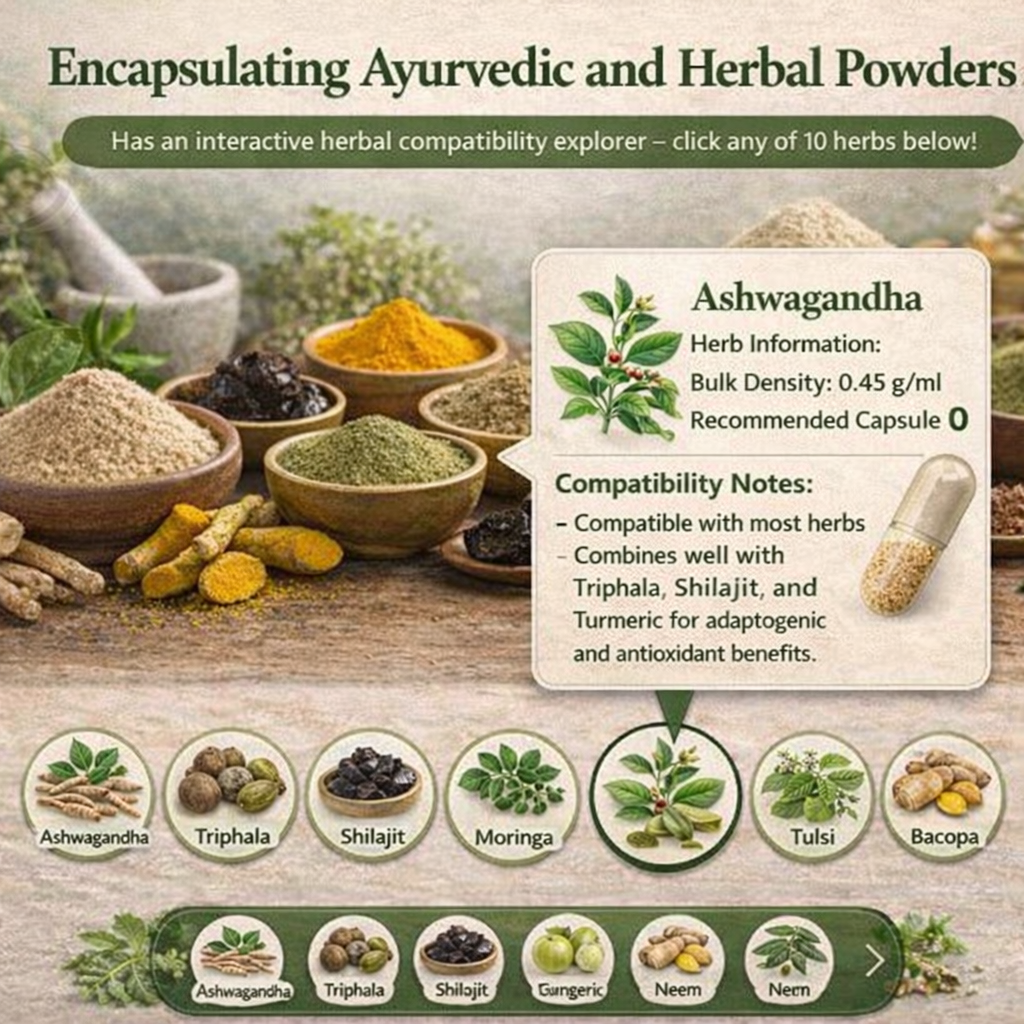
Herbal ingredient compatibility explorer
Click any ingredient to see capsule compatibility notes and recommended size.
Why hard gelatin capsules suit herbal and Ayurvedic formulations
Taste and odour masking
Many Ayurvedic herbs have intensely bitter, astringent, or pungent tastes — ashwagandha, neem, and bitter melon being prime examples. Hard gelatin capsules create a complete physical barrier between the patient and the powder, allowing even the most unpalatable herbal ingredients to be taken comfortably. This improves compliance dramatically compared to loose powder or churna formats.
Precise dosing
Traditional Ayurvedic preparations often involved approximate measures — a pinch, a teaspoon. Capsule encapsulation enables precise, consistent dosing that meets modern regulatory expectations and allows meaningful clinical evaluation of herbal products. This is essential for export to markets that require standardised herbal preparations.
Shelf life and stability
Encapsulation protects herbal powders from atmospheric moisture, oxygen, and light — all of which accelerate oxidation and degradation of active phytochemicals. A well-filled, sealed hard gelatin capsule in appropriate packaging significantly extends the effective shelf life compared to loose or open powder formats.
Export presentation
For herbal supplements sold internationally, capsule format is the preferred presentation in pharmacy and health store channels in the Middle East, UK, USA, and African markets. Buyers in these markets associate capsule format with pharmaceutical quality standards — and reject loose powders or traditional formats as inappropriate for regulated pharmacy sales.
Capsule compatibility with common herbal powders
| Herb | Typical bulk density | Recommended size | Compatibility notes |
|---|---|---|---|
| Ashwagandha (Withania somnifera) | 0.40–0.55 g/ml | Size 0 or 00 | Low density — Size 00 recommended for 500 mg dose. Non-hygroscopic. Good gelatin compatibility. |
| Triphala (blended powder) | 0.50–0.65 g/ml | Size 0 | Moderate density. Slightly hygroscopic — ensure low RH filling room. Good gelatin compatibility. |
| Amla (Phyllanthus emblica) | 0.45–0.60 g/ml | Size 0 or 00 | High vitamin C content — mildly acidic. Check gelatin cross-linking risk from ascorbic acid impurities. Use buffered blend. |
| Neem leaf powder | 0.30–0.45 g/ml | Size 00 or 000 | Very low bulk density. Large capsule required. Non-hygroscopic. Standard gelatin compatibility. |
| Shilajit (standardised extract) | 0.70–0.90 g/ml | Size 1 or 2 | High density extract. Size 1 typically sufficient for 250–350 mg doses. Assess hygroscopicity — shilajit extracts vary. |
| Turmeric (Curcuma longa) | 0.55–0.70 g/ml | Size 0 | Good gelatin compatibility. Bright yellow colour can transfer to gelatin if shell moisture high — store correctly. |
| Brahmi (Bacopa monnieri) | 0.40–0.55 g/ml | Size 0 or 00 | Low density. Non-hygroscopic. Standard gelatin compatibility. Good shelf stability. |
| Moringa leaf powder | 0.25–0.40 g/ml | Size 00 or 000 | Very low density — large capsule needed. Slight hygroscopicity — control filling room RH below 50%. |
Critical formulation considerations for herbal capsules
Moisture management — the most important factor
Herbal powders vary widely in hygroscopicity. Some herbs — particularly those high in polysaccharides, sugars, or hygroscopic phytochemicals — actively absorb moisture from the gelatin shell, causing the shell to become brittle and the powder to cake or clump. The filling room must be maintained at 40%–55% relative humidity, and herbal powders should be dried to a defined moisture specification before encapsulation.
Particle size and flow properties
Herbal powders are frequently fine, cohesive, and poorly flowing — the opposite of ideal for automatic filling machines. Fine powders below 100 microns in median particle size often require granulation or the addition of a glidant (typically colloidal silicon dioxide at 0.5%–1%) to improve flow and achieve acceptable weight uniformity on automatic capsule filling equipment.
Gelatin cross-linking risk
Certain herbal ingredients contain aldehydes or other reactive compounds that can cross-link the gelatin shell, causing the capsule to become resistant to disintegration — a phenomenon known as pellicle formation. Herbs with significant aldehyde content or high reducing sugar levels (including some fruit-derived Ayurvedic ingredients) should be evaluated for gelatin cross-linking potential before bulk production. Using a dissolution aid excipient or switching to HPMC capsules are options if cross-linking is confirmed.
Regulatory requirements for herbal capsule export
Exporting Ayurvedic capsule products from India to international markets involves navigating multiple regulatory frameworks:
- India: Manufacturing must comply with Ayurvedic GMP (Schedule T) or allopathic GMP (Schedule M) depending on product classification. Export licence from APEDA or relevant authority may be required.
- UAE and GCC: Halal-certified gelatin capsule is commercially essential. Product registration with MOHAP or equivalent may be required for pharmacy channel sales.
- Nigeria: NAFDAC registration required for all health products. Herbal capsules classified as dietary supplements or herbal medicines have different registration pathways — confirm with a local regulatory agent.
- UK and EU: Herbal medicinal products require registration under the Traditional Herbal Medicinal Products Directive (THMPD). Dietary supplement classification is more accessible but limits permitted health claims.
Need capsules for your Ayurvedic or herbal product?
Universe Capsules manufactures Halal-certified, TSE/BSE-free hard gelatin capsules in all standard sizes. We supply Ayurvedic manufacturers, herbal supplement producers, and nutraceutical exporters across India and internationally.
Frequently Asked Questions
Are hard gelatin capsules suitable for Ayurvedic powders?
Yes — they are the most widely used format for Ayurvedic products globally. The main consideration is moisture compatibility. Some herbal powders are hygroscopic and must be assessed for interaction with the gelatin shell before bulk production.
What capsule size is most commonly used for Ayurvedic products?
Size 0 and Size 00. Herbal powders typically have low bulk density (0.4–0.7 g/ml), requiring larger capsule volumes for standard 300–800 mg doses.
Do Ayurvedic capsule manufacturers need GMP certification?
Yes. Schedule T for Ayurvedic GMP compliance is required for commercial manufacture in India. For export, WHO-GMP certification is expected by most international markets.
Can Ayurvedic herbal capsules be exported to the Middle East and Africa?
Yes. India is the world's largest Ayurvedic exporter. For Middle Eastern markets, Halal-certified capsule shells are important. For African markets, registration with NAFDAC (Nigeria), PPB (Kenya), or equivalent is typically required.