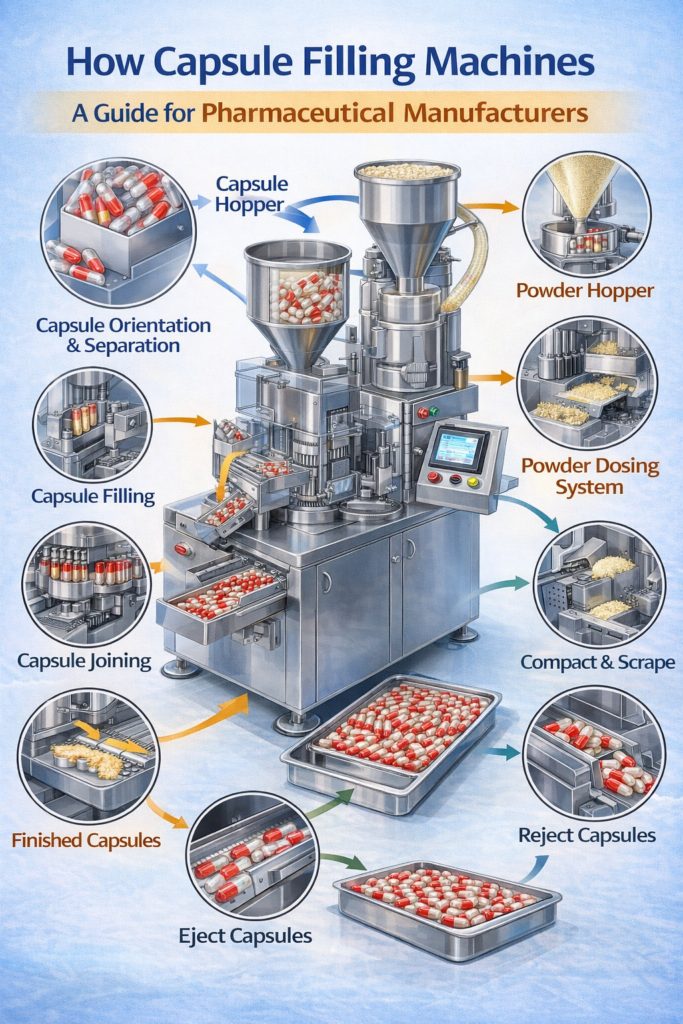
How Capsule Filling Machines Work: A Guide for Pharmaceutical Manufacturers
A pharmaceutical manufacturer's capsule filling machine is only as reliable as the empty capsules going into it. Understanding how automatic capsule filling machines operate — and what capsule properties affect machine performance — is essential for production managers, QC teams, and procurement buyers sourcing empty capsule shells.
This guide from Universe Capsules, a hard gelatin capsule manufacturer in India, explains the key stages of the automatic capsule filling process and the capsule specifications that matter most for machine compatibility.
Interactive: How an automatic capsule filling machine works — step by step
The two main filling machine types
Dosator type
Dosator filling machines
Use a hollow cylindrical tube that plunges into a powder bed to collect a fixed volume, then ejects the plug into the capsule body. Better for free-flowing powders with consistent bulk density. Common brands: MG2, Macofar, IMA.
Tamping pin type
Tamping pin filling machines
Use a series of pins to compress powder progressively into a plug within a dosing disc, then transfer the plug to the capsule body. Better for cohesive or difficult-to-flow powders. Common brands: Höfliger & Karg, Bosch, Zanasi.
Semi-automatic
Semi-automatic & manual fillers
Used for small batches, clinical trials, and compounding pharmacies. Capsules are loaded manually onto a filling plate, powder is spread across the bodies, and caps are pressed on using a hand tamper. Lower output but flexible for small volumes.
What makes capsules compatible with filling machines
The most common cause of poor filling machine performance is not the machine itself — it is the quality and specification of the empty capsules. The following capsule properties directly affect machine output and rejection rates:
Dimensional tolerances
The cap and body diameters of a hard gelatin capsule must be within tight tolerances for the capsule to fit the machine's tooling segments correctly. Capsules that are too wide cause jamming; capsules that are too narrow fail to lock after filling. Universe Capsules manufactures to international pharmacopoeia dimensional specifications with batch-to-batch consistency.
Moisture content
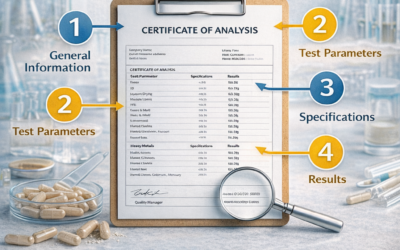
Hard gelatin capsules should contain 13%–16% moisture by weight. Below this range, capsules are brittle and prone to cracking or generating static on the filling machine. Above this range, capsules soften, stick to tooling, and deform during filling. Moisture content is specified on every batch Certificate of Analysis from Universe Capsules.
Cap and body separation force
Automatic filling machines separate the cap from the body using a vacuum system. If the joining force between cap and body is too high, the vacuum cannot separate them, causing machine downtime. Universe Capsules calibrates cap-to-body joining force to allow clean vacuum separation on all standard machine types.
Surface finish and lubrication
Capsule shells are treated with a light pharmaceutical-grade lubricant during manufacturing to allow smooth movement through machine tooling. Insufficient surface lubrication causes friction and jamming; excessive lubrication can transfer to the fill powder and affect dissolution.
Speed, output, and capsule specifications
| Machine type | Output (capsules/hr) | Key capsule requirement |
|---|---|---|
| Manual / benchtop | 500 – 2,000 | Standard dimensions; any moisture range |
| Semi-automatic | 5,000 – 20,000 | Consistent cap-body fit; 13–16% moisture |
| Automatic (low speed) | 20,000 – 80,000 | Tight tolerances; reliable vacuum separation |
| Automatic (high speed) | 80,000 – 250,000+ | Pharmaceutical-grade GMP capsules; full CoA required |
Troubleshooting common filling machine problems
High capsule rejection rate
First check capsule moisture content and dimensional tolerances. A batch of capsules outside specification is the most common root cause. If capsule quality is confirmed good, check machine vacuum settings, segment wear, and powder flowability.
Capsules not separating (cap and body staying joined)
This is typically a vacuum issue or a cap-to-body joining force issue. Increase vacuum pressure first. If the problem persists, test with a fresh batch of capsules — the issue may be high joining force from a capsule batch stored in low-humidity conditions (capsules become stiffer when too dry).
Powder leaking from filled capsules
Usually caused by inadequate capsule locking (cap not fully engaging body) or capsule deformation from moisture damage. Check capsule moisture content and confirm capsule length dimensions are within specification.
Need capsules that run reliably on your filling machine?
Universe Capsules manufactures empty hard gelatin capsules with tight dimensional tolerances and consistent moisture content — designed for reliable performance on automatic filling equipment. Samples available for filling trials before bulk order.
Frequently Asked Questions
What capsule sizes are compatible with automatic filling machines?
All standard sizes from 000 to 5 are supported by changing machine tooling. Most manufacturers run size 0 and size 1 most frequently. Confirm size compatibility with your machine supplier before ordering capsules.
What causes high rejection rates on a capsule filling machine?
Most commonly: capsules outside dimensional tolerances, incorrect moisture content, powder flowability issues, or incorrect machine vacuum settings. Capsule quality from a GMP-certified manufacturer is the first line of defence.
What is the difference between a dosator and a tamping pin filling machine?
Dosator machines plunge a tube into a powder bed to collect powder by volume. Tamping pin machines compress powder progressively into a plug using pins. Dosator machines suit free-flowing powders; tamping pin machines handle cohesive powders better.
How do I know if a supplier's capsules are compatible with my machine?
Run a sample of 1,000 capsules at production speed before bulk ordering. Measure rejection rate, jamming incidents, and locking success rate. Universe Capsules capsules are compatible with all major automatic filling machine brands.