How to Read a Certificate of Analysis for Empty Hard Gelatin Capsules
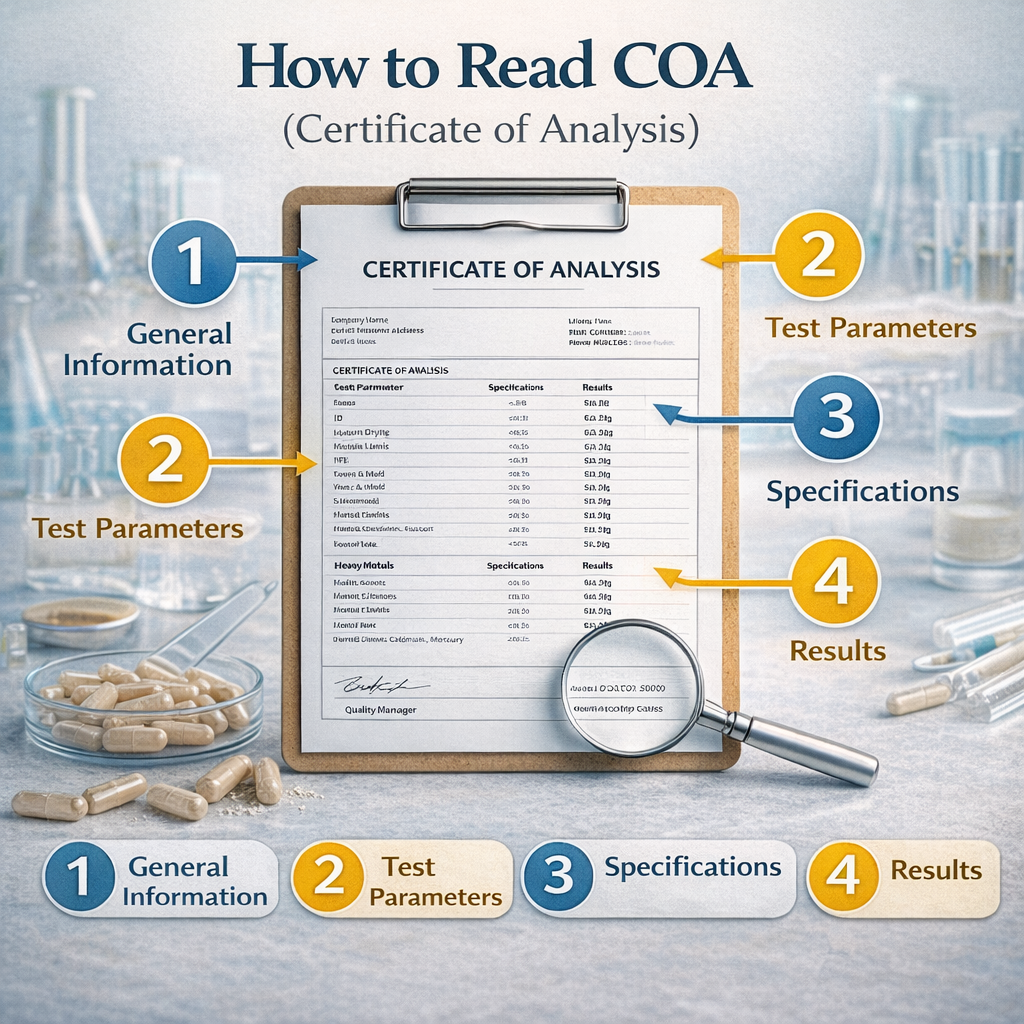
The Certificate of Analysis (CoA) is the most important document you receive from a capsule supplier. It tells you whether the batch you are about to put into production actually meets pharmaceutical quality standards — or whether it doesn't. Yet many pharmaceutical buyers and QC teams accept CoAs without fully understanding what they are reading, what values are acceptable, and what red flags to look for.
This guide from Universe Capsules, a hard gelatin capsule manufacturer in India, walks through every field of a compliant capsule CoA — annotated in plain language.
CERTIFICATE OF ANALYSIS — Empty Hard Gelatin Capsules
Universe Capsules Biotech P. Ltd. | Indore, India | WHO-GMP Certified
Product identification
Product
—
Empty Hard Gelatin Capsules
Must say full pharmacopoeia name — not abbreviations like "EGH" or "EHG"
Size / Colour
—
Size 0 | White / White
Verify this matches your purchase order exactly before reading further
Batch No.
—
UC-2026-04-001
Cross-check this against carton and inner bag labelling — must match exactly
Mfg. Date
—
April 2026
Note manufacture date to calculate remaining shelf life
Expiry Date
—
March 2028
Minimum 18 months remaining shelf life recommended at receipt
Physical and chemical tests
Description
Hard, smooth, white
Complies
Visual appearance must match specification — no dents, specks, or colour variation
Moisture content
13.0–16.0% w/w
14.2%
Mid-range result — ideal. Below 13%: brittle. Above 16%: tacky. Reject if outside 12–17%
Disintegration time
NMT 15 min (IP/BP)
8–11 min
Well within limit. Investigate if result is 13–15 min — may indicate gelatin cross-linking
Cap diameter
7.64 ± 0.10 mm
7.66 mm
Within tolerance. Outside ±0.10 mm causes filling machine jamming or poor locking
Body diameter
7.33 ± 0.10 mm
7.35 mm
Body must be measurably smaller than cap for correct vacuum separation on filling machine
Locked length
21.3 ± 0.30 mm
21.4 mm
Affects filling machine tooling fit — verify against your machine spec before trialling
Microbiological tests
Total viable count
NMT 1,000 CFU/g
< 100 CFU/g
Well within limit — good manufacturing hygiene
Yeast and mould
NMT 100 CFU/g
< 10 CFU/g
Well within limit. Elevated Y&M may indicate moisture ingress during storage or transit
E. coli
Absent/g
Absent
Must be absent. Presence indicates gross contamination — reject batch immediately
Salmonella
Absent/10g
Absent
Must be absent. Critical safety parameter — never waive
Authorised signatory
—
QC Manager [signed]
Must be signed by a named, authorised QC signatory — not stamped only
Red flags — CoA issues that should trigger quarantine or rejection
Watch out for these warning signs
- Batch number on CoA does not match batch number on the carton or inner bag
- Moisture content result outside 12%–17% range (outside this = batch quality risk)
- Disintegration result at or above 15 minutes — limit is being met but barely
- CoA is undated or has no manufacture date — may be a reused document from a previous batch
- Microbiological results are absent or reported only as "within limits" without actual numbers
- No authorised signatory name or only a rubber stamp (no actual signature)
- Dimensions listed without units or without comparison to a specification
- CoA shows no pharmacopoeia reference (IP, BP, USP) for disintegration or other tests
- Expiry date less than 12 months from receipt — insufficient shelf life for most production schedules
Signs of a high-quality CoA from a reliable supplier
- Batch number matches exactly across CoA, carton, and inner bag
- Moisture content reported as an actual percentage (e.g. "14.2%") — not just "complies"
- Disintegration result well within limit (under 12 minutes) with test conditions stated
- Dimensional results shown as actual measurements against specification tolerance
- Microbiological results shown as actual counts (e.g. "<100 CFU/g") not just "pass"
- Named, signed authorised signatory with date of release
- GMP certificate reference number included on CoA header
- TSE/BSE-free declaration and Halal certificate reference included or attached
What to do if a CoA result is out of specification
If any test result on the CoA falls outside its specification, do not accept the batch into production. Quarantine the consignment and notify your supplier in writing, citing the specific parameter and result. A reputable supplier will investigate and respond with a root cause and corrective action. If the supplier disputes the result, arrange for independent retesting at a third-party NABL-accredited laboratory.
Document the quarantine, investigation, and outcome in your quality system. Even if the batch is ultimately accepted after investigation, the record demonstrates your QC process to auditors and regulators.
Want a CoA sample before placing your first order?
Universe Capsules provides a sample Certificate of Analysis for any size and specification on request — so you can verify our documentation standards before committing to a bulk order. Every shipment includes a batch-specific CoA as standard.
Frequently Asked Questions
What should a Certificate of Analysis for empty capsules include?
Product name, size and colour, batch number, manufacture and expiry dates, test results (moisture, dimensions, disintegration, microbiological), pharmacopoeia specifications, and a signed authorised signatory. Any missing element should prompt clarification before accepting the batch.
What moisture content should a capsule CoA show?
Between 13% and 16% w/w per IP/BP specifications. Below 12% — too dry and brittle. Above 17% — too wet and tacky. Results at the edges of the 13–16% range should be investigated against storage conditions.
What is the acceptable disintegration time on a capsule CoA?
NMT 15 minutes per IP/BP. A compliant result is typically 6–12 minutes. Results close to 15 minutes should prompt investigation for gelatin cross-linking or moisture damage.
Can a supplier reuse or alter a Certificate of Analysis?
A genuine CoA is batch-specific. Always cross-reference the batch number on the CoA against the carton and inner bag labelling. Mismatches indicate a documentation problem and the batch should be quarantined pending investigation.