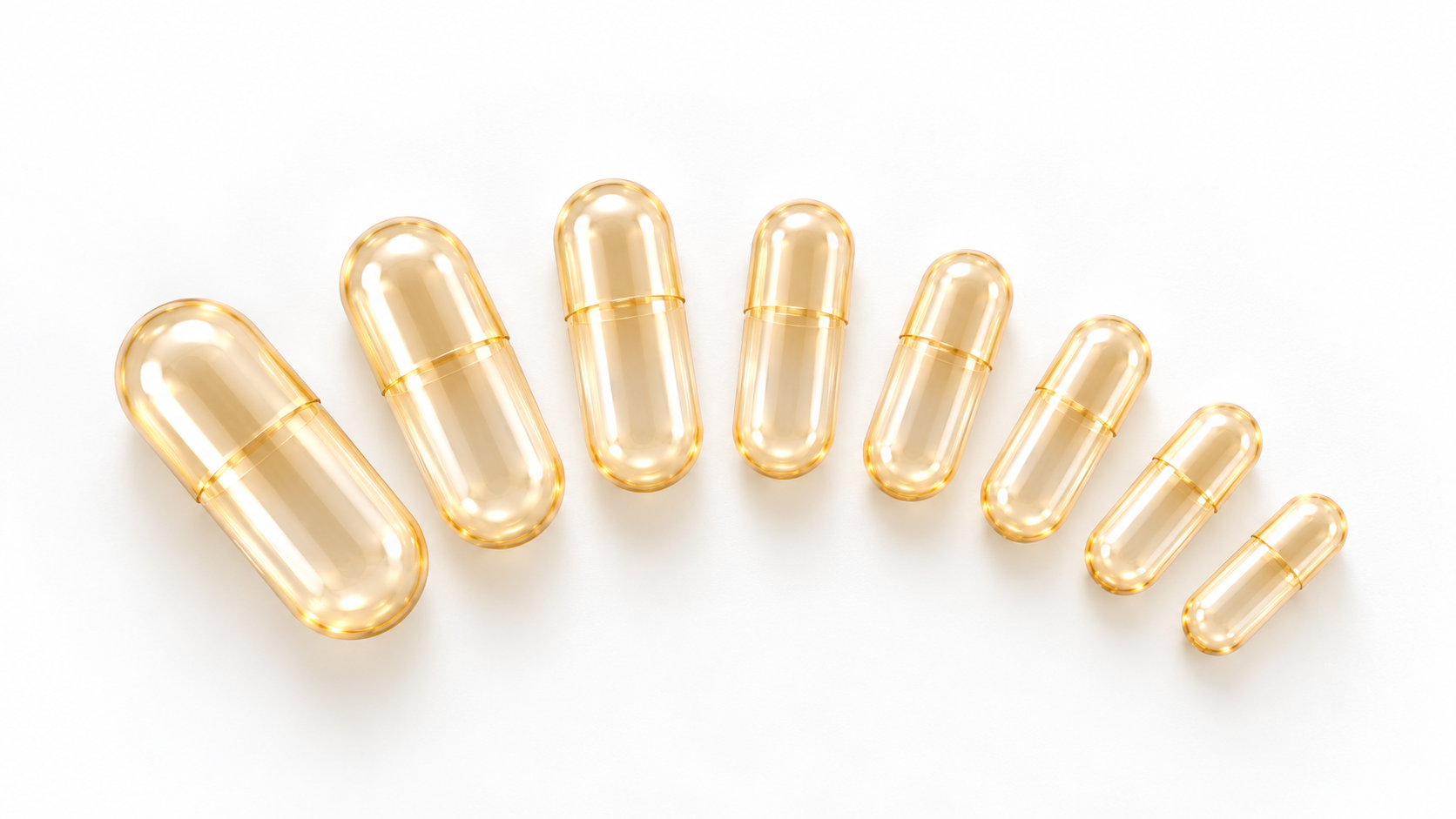
Empty capsules arrive in perfect condition and then spend weeks in a store room before anyone touches them. That store room is where most capsule problems are actually created. A shell that cracks on the filling line, or a batch that has fused into a sticky block, almost never left the factory that way.
The short answer
Store empty hard gelatin capsules between 15°C and 25°C at 35 to 65 percent relative humidity, in their original sealed packaging, off the floor and away from exterior walls. Below 30 percent humidity the shell loses water and turns brittle. Above 65 percent it absorbs water, softens and goes tacky. Correctly stored, capsules keep for three to five years.
Your store room, simulated
Move the sliders to your actual conditions and watch what happens to the shell.
Ideal
These conditions are inside the recommended range. The shell holds its moisture, stays flexible and will run cleanly.
Too dryRecommendedToo humid
Try
Illustrative. Shell response depends on grade, fill and how long the conditions are held.
Why humidity is the one that matters
A hard gelatin shell is not inert. It holds between roughly 13 and 16 percent water by weight, and that water is structural: it is what makes the shell flexible rather than glassy. The shell exchanges moisture with the air around it continuously, moving toward equilibrium with whatever conditions you store it in.
That is why humidity, not temperature, is the variable that destroys capsules. Temperature matters, but mostly because of what it does to humidity and to the speed of the exchange.
Below 30% RH
The shell dries out
Water leaves the gelatin and the shell becomes brittle. You will see splitting at the shoulder, caps that shatter instead of seating, and a rising reject rate on the filling line. Once a shell has gone brittle it does not fully recover, even if you correct the humidity afterwards.
Air conditioning is the usual culprit. A cooled office or store room can easily sit at 20 to 25 percent relative humidity, well below what gelatin tolerates.
Above 65% RH
The shell takes on water
The gelatin softens, the surface turns tacky and capsules begin to stick to one another. Badly affected batches fuse into blocks that cannot be separated without damage. Softened shells also deform under the weight of the capsules above them in the carton.
This is the common failure in humid climates and during monsoon, and it is made worse by storing cartons directly against an exterior wall or on a concrete floor.
Temperature, and the trap people miss
Aim for 15 to 25°C. Sustained heat accelerates moisture loss and, over long periods, can contribute to cross-linking, where the shell becomes progressively harder to dissolve. That one is particularly unpleasant because the capsules look completely normal.
The trap is not heat itself but sudden change. Moving sealed cartons from a cold store into a warm, humid room causes condensation inside the packaging, and the capsules sit in that water until someone opens the box. If you have to move stock between very different environments, let the sealed cartons equilibrate to the new room before opening them.
Seven things to get right
Tick them off. Your score updates as you go.
0 of 7
How long do empty capsules last?
Stored correctly and left sealed, empty hard gelatin capsules typically keep for three to five years. That figure assumes the packaging is intact. Once a bag is opened, the capsules are exchanging moisture with your room air directly, and the useful life becomes a question of your store room rather than the capsule.
Open only what you will use. Reseal properly. If you routinely open a bag, take a handful and leave the rest exposed for a fortnight, your storage conditions have become your shelf life.
Frequently asked questions
What is the best temperature and humidity to store empty capsules?
Store empty hard gelatin capsules at 15 to 25°C and 35 to 65 percent relative humidity. Keep them in their original sealed packaging until use, raised off the floor and away from exterior walls.
Why are my empty capsules brittle and cracking?
The air is too dry. Below about 30 percent relative humidity, gelatin shells lose structural moisture and become brittle, which causes splitting and cracking during handling and filling. Air-conditioned rooms are a frequent cause.
Why are my capsules sticking together?
The air is too humid. Above roughly 65 percent relative humidity the shells absorb moisture, soften and become tacky, which makes them adhere to each other and deform under the weight of stock above them.
What is the shelf life of empty gelatin capsules?
Three to five years when stored correctly in sealed original packaging. Once opened, shelf life depends almost entirely on the storage conditions the capsules are then exposed to.
Can brittle capsules be restored?
Not reliably. Re-humidifying a brittle batch may soften it, but the shell rarely returns to its original mechanical properties, and uncontrolled re-humidification risks over-correcting into tackiness. Prevention is the only dependable approach.
Should empty capsules be refrigerated?
No. Refrigeration is unnecessary and introduces condensation risk when the capsules are brought back to room temperature. A stable room within the recommended range is better than a cold one.
Capsules packed to survive the journey
We heat seal in food-grade polyethylene and pack into corrugated cartons lined with thermocol on all six sides, so your capsules arrive in the condition they left in.
Request a sample