Hard gelatin capsules and softgels are both made from gelatin, and both are among the most popular ways to take medicines and supplements. But they are built differently, filled differently and suit very different products. Here is a clear comparison to help you choose the right one for your formulation.
The short answer
Hard gelatin capsules are two-piece shells (a cap and a body) filled with dry powders, granules or pellets. Softgels are one-piece, sealed shells, softened with a plasticiser, that hold liquids such as oils. Choose hard capsules for powders and fast, flexible production; choose softgels for oils and liquid fills.
Hard gelatin capsules vs softgels: side by side
| Feature | Hard gelatin capsules | Softgels |
|---|---|---|
| Structure | Two pieces, a cap and a body, that lock together | One piece, hermetically sealed |
| Shell | Gelatin with water; rigid and thin | Gelatin with a plasticiser such as glycerin; flexible and thicker |
| Typical fill | Powders, granules, pellets, mini-tablets | Oils, liquids, suspensions, pastes |
| Common products | Antibiotics, multivitamins, herbal and Ayurvedic powders, probiotics | Fish oil, vitamin E, vitamin D in oil, liquid painkillers |
| Who fills them | Brands and pharma companies fill empty capsules on their own machines | Usually made and filled in one step by a specialist softgel manufacturer |
| Batch flexibility | Small trial batches to very large runs | Best suited to large runs |
| Development time | Fast; simple powder blends can be filled quickly | Longer; needs a liquid formulation and dedicated tooling |
| Sizes | Standard sizes 000 to 5 | Many shapes such as oval, oblong and round |
| Colours and printing | Wide range of shades, two-tone, pearl, metallic and printing | Coloured or clear shells |
When to choose hard gelatin capsules
- Your active ingredient is a dry powder, granule or pellet.
- You want to fill in-house, with control over batch size and timing.
- You need to launch quickly or run small trial batches.
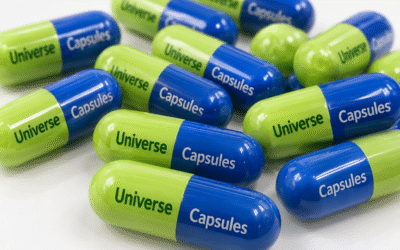
- You want strong branding with two-tone colours or printing. See custom capsules.
- You want a simple formulation without binders or compression. See capsules vs tablets.
When softgels make more sense
- Your ingredient is naturally an oil, such as fish oil or vitamin E.
- The active must be dissolved in a liquid for absorption.
- You are producing very large volumes of a single product with a contract softgel manufacturer.
How each is made
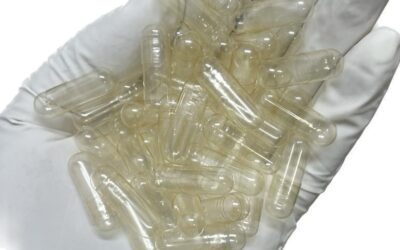
Hard gelatin capsules are made by dipping stainless steel pins into a gelatin solution, drying the film, then stripping, trimming and joining the cap and body. The empty capsules are supplied to the brand, which fills them. See how we manufacture capsules.
Softgels are formed from two ribbons of plasticised gelatin, filled with liquid and sealed in a single step on a rotary die machine.
Do both dissolve the same way?
Both shells are gelatin, so both dissolve in the stomach. Universe Capsules' hard gelatin capsules disintegrate within 15 minutes in purified water at 37°C. Read more on dissolution and disintegration.
Frequently asked questions
What is the difference between a hard capsule and a softgel?
A hard gelatin capsule is a two-piece shell filled with dry powder or granules. A softgel is a one-piece, sealed, flexible gelatin shell that holds a liquid such as oil.
Are softgels made of gelatin?
Yes, most softgels are made of gelatin softened with a plasticiser such as glycerin, which makes the shell flexible.
Which is better, a hard capsule or a softgel?
Neither is better in general. Hard capsules suit powders and flexible in-house filling; softgels suit oils and liquid formulations.
Can I fill hard gelatin capsules myself?
Yes. Empty hard gelatin capsules can be filled by hand, on semi-automatic or on automatic machines. Softgels must be made by a specialist manufacturer.
Does Universe Capsules make softgels?
No. Universe Capsules manufactures empty hard gelatin capsules in sizes 000 to 5.