Capsule Weight Uniformity Testing: Pharmacopoeia Requirements and How to Conduct It
Weight uniformity is one of the most fundamental quality tests performed on filled capsule products. It verifies that every capsule in a batch contains approximately the same amount of fill — and therefore approximately the same dose of active ingredient. A batch that fails weight uniformity has unacceptable dose variation across its units, which is a patient safety issue and a regulatory non-compliance.
This guide from Universe Capsules, a hard gelatin capsule manufacturer in India, explains the pharmacopoeia requirements, testing procedure, and how to use the interactive calculator below to assess your own batch results.
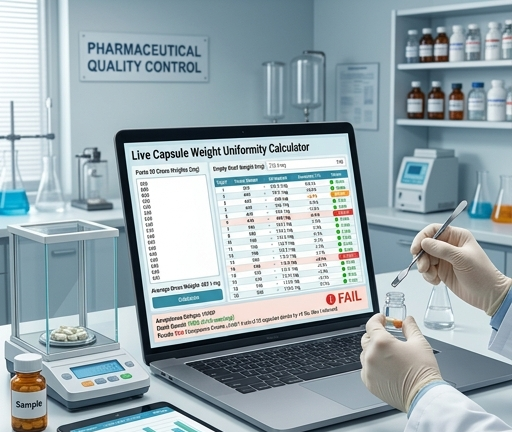
Weight uniformity calculator — IP/BP method
Enter 20 filled capsule gross weights and the average empty shell weight. The calculator applies IP/BP acceptance criteria automatically.
Pharmacopoeia specification for weight uniformity
The Indian Pharmacopoeia (IP) and British Pharmacopoeia (BP) specify identical weight uniformity requirements for hard gelatin capsules:
- Weigh 20 capsules individually. Calculate the fill weight of each (gross weight minus empty shell weight).
- Calculate the mean fill weight of the 20 capsules.
- For mean fill weight ≥ 300 mg: no more than 2 capsules may deviate from the mean by more than ±7.5%; none may deviate by more than ±15%.
- For mean fill weight < 300 mg: no more than 2 capsules may deviate from the mean by more than ±10%; none may deviate by more than ±20%.
Step-by-step testing procedure
Step 1: Sampling
Select 20 capsules at random from the batch, sampling from different positions in the batch (beginning, middle, and end of fill run where possible). Label each capsule 1–20 and weigh on a calibrated analytical balance to the nearest 0.1 mg.
Step 2: Empty shell weighing
Open each capsule, remove the fill contents completely, and weigh the empty shell (cap + body). Record each shell weight. Calculate the average shell weight across all 20 capsules — use this average to calculate individual fill weights (gross weight minus average shell weight per IP/BP method).
Step 3: Fill weight calculation
For each capsule: Fill weight = Gross weight − Average shell weight. This gives 20 individual fill weights.
Step 4: Statistical analysis
Calculate the mean of the 20 fill weights. For each capsule, calculate the percentage deviation from the mean: % deviation = ((individual fill weight − mean fill weight) ÷ mean fill weight) × 100. Apply the appropriate acceptance criterion based on mean fill weight (≥300 mg = ±7.5%; <300 mg = ±10%).
Step 5: Acceptance / rejection decision
Count capsules outside the ±7.5% (or ±10%) limit. If 2 or fewer are outside the limit and none exceed the ±15% (or ±20%) absolute limit, the batch passes. If 3 or more are outside the primary limit, or any capsule exceeds the absolute limit, the batch fails and requires investigation.
Root cause analysis when weight uniformity fails
| Failure pattern | Most likely root cause | First investigation step |
|---|---|---|
| Random high variation — no pattern | Poor powder flow / segregation | Measure powder bulk density and flow angle of repose |
| Systematic drift — weights increase or decrease over run | Dosing system wear or clogging | Inspect dosator or tamping pin for blockage or wear |
| Bimodal distribution — two clusters of weights | Blend non-uniformity / segregation | Sample blend from multiple positions, test API content |
| All weights low | Overfilled capsule body volume / low bulk density | Re-measure bulk density, review capsule size selection |
| Occasional outliers only | Double-fill or missed fill event | Inspect machine cycle sensor and rejection system |
Weight uniformity vs content uniformity
Weight uniformity is a surrogate test — it assumes that if fill weight is uniform, API content is also uniform. This assumption holds when the API is a major component of the blend and is well mixed. But for low-dose APIs (below 25 mg per capsule or below 25% of the fill by weight), content uniformity testing — direct measurement of API in individual capsules by HPLC — is required instead of weight uniformity per pharmacopoeia. Confirm with your regulatory affairs team which test applies to your specific formulation.
Consistent capsule shells mean consistent fill weights
Universe Capsules manufactures empty hard gelatin capsules with tight shell weight tolerances — reducing a key variable in your weight uniformity calculation. Every batch CoA includes shell dimensional and weight data.
Frequently Asked Questions
What is the pharmacopoeia limit for capsule weight uniformity?
Per IP/BP: for fill weights ≥300 mg, no more than 2 of 20 capsules may deviate by more than ±7.5% from the mean; none may exceed ±15%. For fills <300 mg, limits are ±10% and ±20% respectively.
How many capsules are sampled for a weight uniformity test?
20 capsules per IP/BP method. Each is weighed, emptied, and the shell weighed. Fill weight = gross weight minus average shell weight.
What causes capsule weight uniformity failure?
Poor powder flow, worn filling machine components, blend segregation, incorrect capsule size, or bulk density variation across the batch. Root cause depends on whether variation is random, systematic, or bimodal.
Is weight uniformity the same as content uniformity?
No. Weight uniformity is a surrogate. Content uniformity directly measures API amount per capsule by HPLC. For low-dose APIs (<25 mg or <25% of fill), content uniformity testing is required instead.