Paediatric Capsule Formulations: Selecting the Right Capsule Size for Children's Medicines
Children are not small adults. This principle — well established in clinical pharmacology — extends directly into pharmaceutical formulation. A capsule product designed for adults cannot simply be downsized for children without careful consideration of dose appropriateness, capsule size, swallowability, and the unique regulatory requirements that govern medicines for paediatric populations.
This guide from Universe Capsules, a hard gelatin capsule manufacturer in India, explains how to approach capsule size selection, dose flexibility, and age-appropriate design for paediatric capsule formulations.
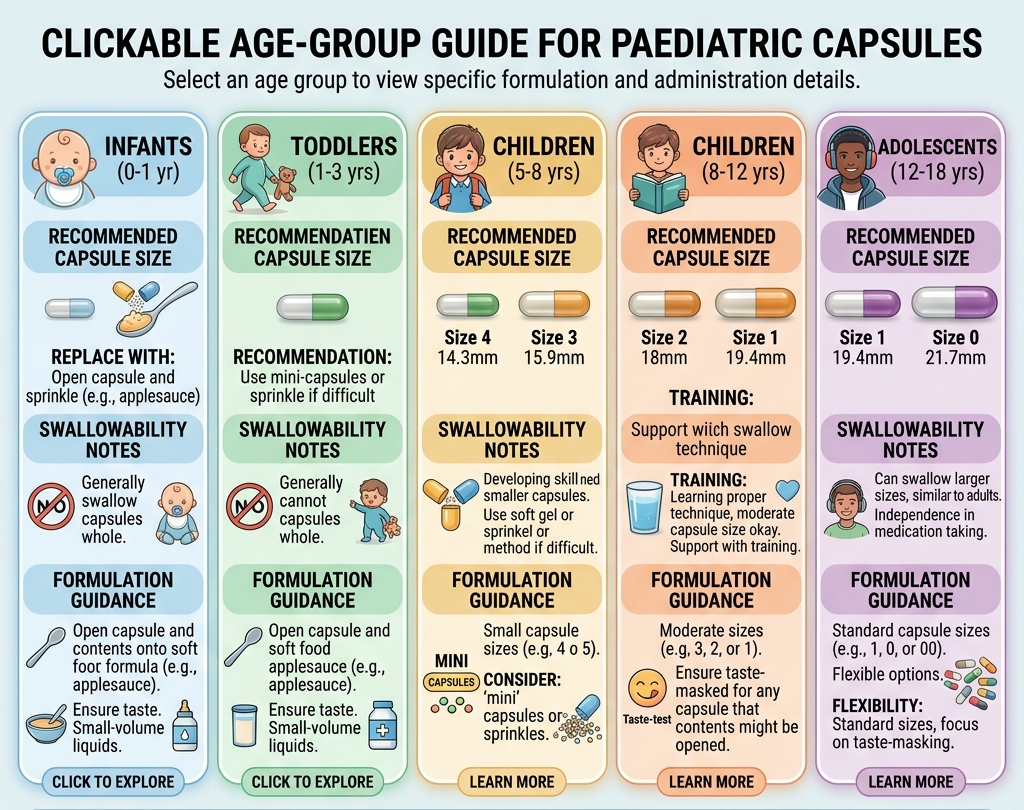
Paediatric capsule size guide by age group
Click an age group to see recommended capsule sizes, swallowability considerations, and formulation notes.
000
Adult / large dose only
00
Adult / adolescent
0
Adult / older adolescent
1
Adolescent 12+
2
Children 8–12
3
Children 6–12 ✓
4
Children 4–8 ✓
5
Children 3–6 ✓
Orange highlights indicate sizes most commonly used in paediatric formulations. Adult sizes shown for reference.
Why paediatric capsule formulation requires a different approach
Body weight-based dosing
Most paediatric medicines are dosed on a mg/kg basis — the dose is calculated from the child's body weight rather than being fixed. This creates a fundamental challenge for capsule formulation: a single fixed-strength capsule cannot accurately serve a paediatric population with weights ranging from 5 kg (infant) to 40 kg (older child). Solutions include developing multiple strengths, allowing dose splitting (where formulation permits), or using flexible fill-weight compounding approaches.
Swallowability assessment
The physical size of the capsule directly determines whether a child can swallow it. Size 0 capsules (21.3 mm length) present a significant swallowing challenge for most children under 12. Research consistently shows that capsule length is more predictive of swallowing difficulty than diameter — making smaller capsule sizes (3, 4, 5) preferable for younger children even when a larger capsule could theoretically accommodate the required fill weight.
Taste and acceptability
Unlike adults who typically swallow capsules whole, some paediatric patients — particularly younger children — may open or bite the capsule, exposing the fill. Formulations should be designed with acceptable taste properties in case of accidental opening, and labelling should clearly state whether capsule contents can be mixed with food or liquid for children who cannot swallow capsules whole.
Age-appropriate capsule sizes — reference table
| Age group | Typical body weight | Recommended capsule size | Key considerations |
|---|---|---|---|
| Infants (0–2 years) | 3–12 kg | Not recommended | Liquid formulations preferred; capsule swallowing not developmentally appropriate |
| Toddlers (2–5 years) | 12–20 kg | Size 5 (with training) | Very small capsule only; swallowability training required; liquid preferred |
| Children (5–8 years) | 18–28 kg | Size 4 or 5 | Capsule swallowing achievable with training; small sizes essential |
| Older children (8–12 years) | 25–45 kg | Size 2 or 3 | Most children can swallow size 2–3; assess individually |
| Adolescents (12–18 years) | 40–70 kg | Size 0 or 1 | Adult dosage form usually appropriate; assess for smaller patients |
Regulatory requirements for paediatric capsule products
Pharmaceutical companies developing capsule products for paediatric use must satisfy specific regulatory requirements beyond those for adult medicines:
- EMA (Europe): Paediatric Investigation Plans (PIPs) required for all new medicines; paediatric formulation must be appropriate for target age group
- USFDA (USA): Paediatric study requirements under PREA and BPCA; age-appropriate formulation required
- WHO: Model list of Essential Medicines for Children guides paediatric formulation development in developing markets
- India (CDSCO): Follows international guidelines; paediatric formulations for export must meet destination market requirements
Need small capsule sizes for paediatric formulations?
Universe Capsules manufactures empty hard gelatin capsules in sizes 000 to 5, including the smaller sizes most commonly used in paediatric pharmaceutical formulations. Full GMP documentation provided.
Frequently Asked Questions
What is the smallest capsule size suitable for children?
Sizes 3, 4, and 5 are most commonly used for paediatric formulations. Size 3 suits children 6–12 years; sizes 4 and 5 for younger children and very low doses. Swallowability assessment in the target age group is always recommended.
Can children swallow hard gelatin capsules?
Many children aged 6+ can learn to swallow capsules with guidance. Swallowability training programmes achieve success even in children as young as 4–5 for very small capsule sizes. Smaller capsule sizes significantly improve outcomes.
What is dose flexibility and why is it important?
Dose flexibility is the ability to adjust dose to match body weight. Children require weight-based (mg/kg) dosing. Capsules provide flexibility through fill weight adjustment — different doses in the same shell without reformulation.
Are there specific regulations for paediatric capsule formulations?
Yes. EMA requires Paediatric Investigation Plans; FDA has PREA and BPCA requirements. WHO publishes paediatric formulation guidance. All require age-appropriate presentation and dosing flexibility.